
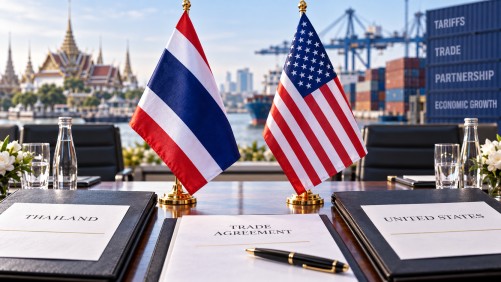
Thailand is actively pursuing a reciprocal trade agreement with the United States as it seeks to safeguard its exporters from the threat of increased tariffs. This move comes amid ongoing discussions to resolve outstanding issues in the Agreement on Reciprocal Trade (ART), which aims to provide Thai exporters with more certainty and competitive market access.
Bilateral negotiations have been underway with no fixed deadline set for the completion of the ART. The talks are partly motivated by the potential imposition of a 12.5% tariff on Thai goods under a Section 301 measure, which targets imports suspected of being produced using forced labor. Additionally, a U.S. investigation into structural excess production capacity, initiated in March 2026, could lead to further duties on Thai exports. This probe includes Thailand among several other significant trading partners.
In response, Thai officials have presented data to the U.S., challenging the claims of excess production capacity and the potential transshipment of goods. They argue that the production capabilities in some of Thailand’s key industries exceed previous U.S. estimates, seeking to update Washington’s current understanding and assessment.
Thailand’s efforts to finalize the trade agreement also aim to align its tariff treatment with that of regional competitors such as Malaysia and Indonesia. Officials believe that an ART could facilitate improved market access for Thai products, although the definitive terms of the tariffs are still under negotiation.
Aside from addressing tariff issues, the proposed agreement seeks to tackle U.S. concerns over trade barriers, investment, and access to Thailand’s markets. Any finalized deal would need to undergo approval through Thailand’s domestic procedures before it could be enacted.